for , while, do-while

Iterative(repeatedly) Control Instruction:- It is used to execute a code, multiple times.It is also of 3 types.

  1. for loop
  2. while loop
  3. do-while loop
1) for loop-
   syntax : for keyword(initialization,condition,increment/decrement)
              {
               //body
               }
example:
Explanation:- 1) go to main
2)declare x 
3) x initialize to 1, check condition 1<4 correct, print hello then x is increment x++ i.e x become 2 check condition again 2<4 correct print again hello then again increment x=3 , check 3<4 print again hello now 3 hello is print again increment now x become 4 check 4<4 no condition false exit for loop.

2) while loop:
   syntax:- while keyword(condition)
                 {  ---;  increment/decrement  }
example:
Explanation:- 1) go to main

2)declare x and initialize to 1
3) check condition 1<4 correct, print hello then x is increment x++ i.e x become 2 check condition again 2<4 correct print again hello then again increment x=3 , check 3<4 print again hello now 3 hello is print again increment now x become 4 check 4<4 no condition false exit for loop.

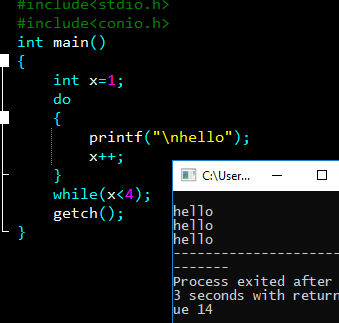
3)do while:- It is different from for and while loop, in both the loop first condition is check then statement is print, but in do while before condition a statement can be print.
while is terminate here by ;(semicolon) 
syntax:- do{
               ----;
               }
              while(condition);
example:-
 Explanation:- 1) go to main


2)declare x and initialize to 1
3) go to do then directly print hello increment x by 1 now x=2, go to while loop check condition 2<4 true now go to do body print hello  and so on.

Comments

Popular Posts

Type casting

type casting or type conversion  allows us to convert one data types into another.for type casting cast operator is required. Syntax:--      (type)expression or value; Example:       int f =9/4; //without type casting       o/p=2       float f=(float)9/4;  //with type casting       o/p=2.3 Type conversion are of two types: 1)Implicit Type Conversion:-  it is also known as automatic type conversion.When the type conversion is performed automatically by the compiler,such type of conversion is known as implicit type conversion. 2)Explicit Type Conversion:-  the type conversion performed by the programmer is known as explicit type conversion.which is done by cast operator as above mentioned.

UNION

Definition:-                 Union is similar to structure, except it allows you to define the variable that share storage spaces.Defining a means creating a new data types. How use union:-                       when we create a structure by using struct keyword, now making a union we just replace the keyword struct with the keyword union , other syntax will be same. Difference  between Structure  and Union:- the only difference between them is in memory. NOTE:-  union is used for low level programming but structure mostly used for high level programming. Program to access union:- """SHARE IT WITH YOUR FRIENDS IF HE DID NOT KNOW""""

Recursion--

Definition:- when a function call itself is called recursion. note:- the problem which is solved by recursion is also solved by loops, but it is not necessary the problem solved by loops is also solved by recursion.  Example:- Explanation:- 1) a fun function declared which takes argument and return value 2) main starts fun is called by passing 3 value 3)after calling fun definition starts, where check if a==1 no because a is 3, s=a+fun(a-1) means s=3+fun(2)  from here fun function is again called now this body again execute now a is 2, so s=3+fun(2), fun(2) is replaced by 2+fun(2-1=1) i.e s=3+2+fun(1) again fun function is called... overall s=3+2+1=6, s is return this return value goes where fun function is called , where return value is stored in k, so k=6 now print is 6.